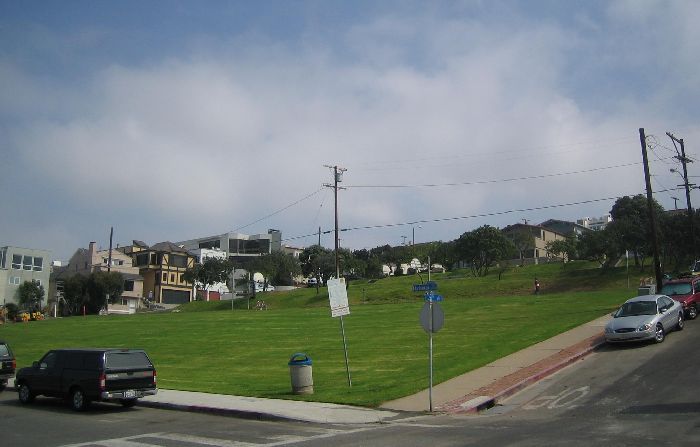
Parque Culiacan, Manhattan Beach, California

Photos by William Cooper, text by Mark R. Hatlie

These pictures were taken on September 17, 2005.

This park is located in my home town of Manhattan Beach, California. Since research done by local high school teacher and activist Bob Brigham in the 1960s, it has been known that the city got the land for this park by using eminent domain laws to evict four black families in the 1920s. I am still doing some research into the history of this marker, which was put up in 2003, so my comments (see bottom) are still somewhat speculative and very general.

This picture shows the park with the Pacific Ocean in the background. It is prime real estate today.
Here is the park from the beach side, looking up the hill to the east.
The park was recently re-done with new benches and this new sign.
Upon closer inspection, the sign turns out to be an historical marker of no small signifigance for the city. The plaque reads:
Formerly the site of Bruce's Beach, a resort for African American Angelenos. This two-block neighborhood also housed several minority families and was condemned through eminent domain proceedings commenced in 1924. Those tragic circumstances reflected the views of a different time.
Named Bayview Terrace Park in 1962 through a community contest. Prior to that time, the land was referred to as City Park and Beach Front Park.
Designated Parque Culiacan on March 16, 1974 at the time of a visit from representatives of our first sister city.
Parque Culiacan commemorates our community's journey to the understanding that friendship, goodwill and respect for all begins within our own boundaries and extends to the world community.
Signed and donated by the Leadership Manhattan Beach Class of 2003
This message is rather cryptic. George Peck was an important figure in early Manhattan Beach history; there is a street named after him. What it means that he sold the land, "for minorities", I am not quite sure. But for the next 10 years or more, the land was used by African Americans.

To get another view of the marker, go to the City of Manhattan Beach's Parks and Recreation page.

Since this is my home town and this marker is so tied up with my own personal identity, I will comment more here than usual, despite not having completed my background research.

On the one hand, this incident from the 1920s may seem like this medium-sized town's one blemish and it is good that this is finally being publicly recognized. While the use of passive voice and the responsibility of circumstances on the marker conveniently avoid the question of who is or was actually responsible, this kind of wording is common on markers and should not be condemned too harshly.

While some deeds may seem less reprehensible if they "reflected the views of a different time", in this case I think the case is the other way around. This is an example of an historical event which gains signifigance when seen in the wider context. We need to take the word "circumstances" on the marker seriously. The marker does well to point out that attitudes and circumstances in the 1920s were as they were. But by imbedding the tragedy into the context of the history of the park's changing names, the marker still gives the impression of an isolated incident, which dramatizes the sense of place, but shields the visitor from recognizing that segregation (spatial, economic, political) was pervasive throughout Los Angeles for decades. It remained legal until 1948 and common practice until well into the 1950s to prevent minority families from living in certain areas by explicit clauses on property deeds. I don't know if Manhattan Beach had these legal provisos, but the Bruce's Beach incident shows that other uses of state and legal force were possible even here. In the 1920s and 1930s, the White Knights, a KKK-like white supremacist organization, flourished in Los Angeles. In Manhattan Beach, they attacked and beat up at least one homosexual in the mid 1930s (I would really like to know more about whether they had a Manhattan Beach chapter and whether incidents like this were common). The transportation policies of the 1920s to 1970s further solidified segregation, protecting Manhattan Beach from integration, stagnating or declining property values, etc. The political battles of race and urban space continued at least into the school busing politics of the 1970s and 1980s and could be said to be still raging today.

Thus, this marker is beginning to put public, explicit contour on Manhattan Beach's place in a wider historical context involving the whole country, but especially Los Angeles. I guess my point is this: The "tragic circumstances" were not just a few houses and families on some beachfront property in the 1920s. They are that the city without a history that I grew up in has a history after all. While I grew up facing west, out to the ocean, proud that my home town was mentioned in Surfin' USA by the Beach Boys, there was, the whole time, a history that ties the city into the east. There is no complete history of Manhattan Beach without a history of Watts, Carson, and East L.A. We may fly or drive over those places and never go there, but we are tied to those places by a common history that is not a national abstraction, but local reality well within living memory that transcends the Great Wall that is the 405.

This is not about showing up the people of my home town to be racist or to "unmask" anything for purposes of attack. Indeed, the people I knew while growing up there after 1970 were, for the most part, tolerant and open and neighborly. But to the extent that history should be about tearing down explicit or implicit myths about why things are the way they are now, I would like to help draw attention to how this marker shows the "circumstances" under which our way of life was built.


Collected Sites:

By Location

By Theme

Galleries

(under construction)

Student Projects


Contact / Impressum:
Mark R. Hatlie (ViSdM)
Im Feuerhägle 1
D-72072 Tübingen
Germany

+49-7071-792696
www.hatlie.de
sitesofmemory @ hatlie.de


Resources:

Recommended Reading

Offsite Sites

Sign my Guestbook from Bravenet.com